
Buenaventura
An independent cultural centre in Castelfranco Veneto (north-east Italy, 40 km from Venice), known as "il Buena": its venue was open from 1999 to 2007, with music, conferences and workshops. The association still exists, and since 2026 it has been starting up again.
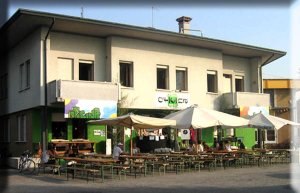
Oficina di Buenaventura — known as “il Buena” — was a self-organized cultural centre in Castelfranco Veneto, a small town in the Veneto region of northern Italy, between Venice and the Dolomites.
📍 Where: Castelfranco Veneto on OpenStreetMap · about 40 km north-west of Venice, 30 km east of Vicenza, 50 km south of the Dolomites.
1999–2007: the 8 years that made it
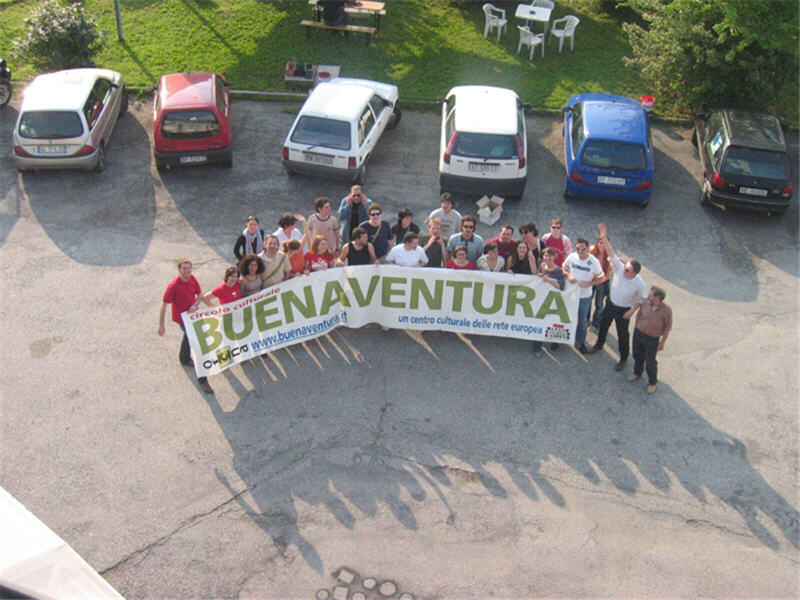
For eight and a half years (summer 1999 – December 2007), the Buena occupied a 600 m² building on three floors plus a basement in Via Circonvallazione Ovest 23, in Castelfranco Veneto.
It was open every day. It had a stage, a bar, a kitchen, a theatre, a cinema room, a gallery, a guest room, rehearsal rooms, language classrooms.
The numbers of an average year (2006–2007):
- 3,000–4,000 members per year
- ~80 concerts per year (around 90 bands in 2006 alone)
- ~10 theatre performances per year
- ~200 socio-cultural initiatives per year
Music ran across several curated series: Basemental (indie / post-rock / experimental / noise), Castelfranco In-fest (punk / hardcore), jazz, world music. Live at the Buena, among many others: Bob Corn, Cyann & Ben, Charalambides, Dean Roberts, Drekka, Father Murphy, Franklin Delano, Fuzz Orchestra, Gowns, Lake District, MAM, Marzipan Marzipan, Musica da Cucina, One Dimensional Man (Capovilla), Ovo, Paul Flaherty + Chris Corsano, Picastro, Ronin, Settlefish, Vinicio Capossela, Xabier Iriondo, and well over a hundred more.
Two musicians in particular kept showing up for free, often, at the Buena: Alberto Cantone (singer-songwriter — his Fabrizio De André tribute of October 2001 at the Buena is still remembered) and Tolo Marton (blues guitarist, who also dropped by often to give advice). Among local-scene voices, also Ricky Bizzarro (frontman of Radiofiera, opinion leader of the Treviso area) came in March 2005 for an informal music-and-talk evening titled “Trevigiani alzate la testa” (covered by La Tribuna di Treviso).
Conferences hosted Elio Veltri (journalist, ex-magistrate), Marco Travaglio, the magistrate Gian Carlo Caselli, Tina Anselmi (Italian partisan and former Minister of Labour, from the Castelfranco area), the psychiatrist Paolo Crepet, and many others — usually packed.
Workshops covered languages (Spanish, German, Portuguese, Italian for foreigners), dance (flamenco, tango, salsa, capoeira), photography, theatre, video, scriptwriting, free software, marketing, social communication.
In 2006 the Veneto Region selected Buenaventura, out of more than 200 youth-participation experiences in the region, as the only model based on full self-management and self-financing.
European network
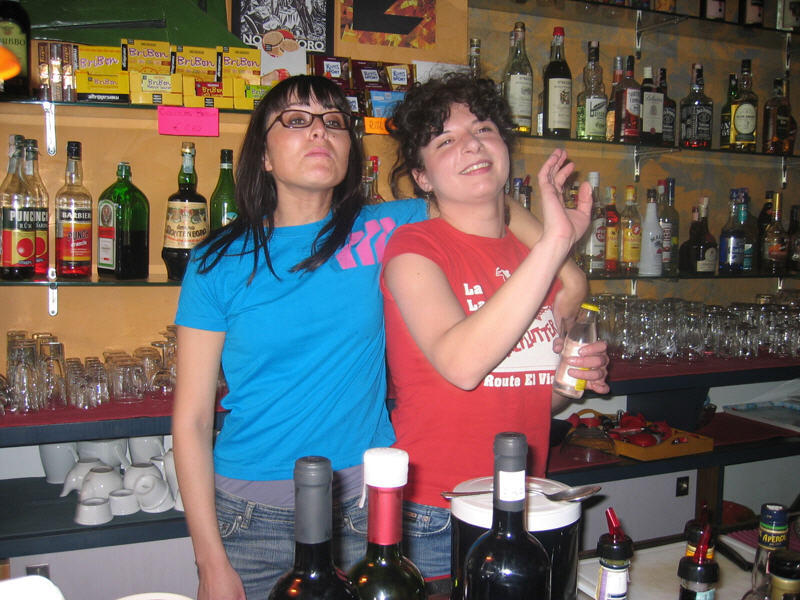
Buenaventura was an active member of Trans Europe Halles (TEH), the European network of independent cultural centres founded in 1983.
Volunteers travelled to TEH meetings in Barcelona (2002, first contact), Birmingham (2003), Lund (Sweden, 2004), Berlin (2005), Ljubljana (2006), Bremen (2006), Helsinki (2007).
In May 2005, the Buena hosted the 59th TEH meeting in Castelfranco Veneto — over 70 delegates from across Europe, theme “The DNA of independent Cultural Centres”. (See the archived event website, the photo gallery, and the project archive ArcheNet born from it.)
How it felt — the alchemy
The top floor was a foresteria: a guesthouse where, on average, six volunteers lived, sharing the building with the activities below. It worked like a small commune. The big shared kitchen — on the floor just below — was open to the residents and to all members of the association, and was used for collective dinners and lunches: many Buena members would come up at midday and eat with whoever was living upstairs. On warm evenings the meals spilled one floor up onto the top-floor terrace, with its open fireplace and view of the Prealps and Monte Grappa.
That kitchen, and a couple of spare beds, were also the reason a steady stream of touring musicians passing through Northern Italy kept knocking. They got a meal, a place to sleep, an evening of company — and in exchange they played one or two nights downstairs. Many of them, after one stay, stopped being “the band on tour” and became amici del Buena: friends of the Buena, who came back year after year on their tour, for free, because they had found something there they did not find on the rest of the road.
Castelfranco in those years was an economically rich, fast-growing town in one of the wealthiest provinces of Italy. And yet, for the young people of the area, the Buena was one of the very few places where you could pause, find the words for what you were feeling, look at the world properly, take it in. Friendships, attachments, loves long and short — but never superficial: a great deal of life began inside those rooms. People who walked through the Buena recognised, almost immediately, that what was happening there felt natural — and yet was hard to come across anywhere else.
There was a strange alchemy at work: a big willpower, a deep trust in human beings, a desire and a daily practice of freedom — held together by one quiet rule. The Buena never let the ends justify the means. Whatever the goal — opening on time, putting on the concert, finishing the project — the means used to reach it had to be coherent with the goal itself. Otherwise the goal got contaminated, and was no longer worth reaching. That coherence is a bel vivere, a beautiful way of living, which everyone who passed through tried, later, to apply in their own life — in their relationships, and in their professional work.
You can spot a Buenaventino (someone shaped by the Buena) in seconds. Even between jokes, they go straight to the point. They recognise on the spot the stench of power, and they don’t get along with it. They are careful not to take advantage of others, and they are particularly pleased when they can bring along the weaker, or whoever didn’t end up at the top of the queue. It is, in the end, a self-fulfilling prophecy in the most positive sense: an extreme trust in other people, used as the instrument that creates the very conditions in which everyone, in fact, gets better.
December 2007: Uscita di Emergenza
The lease ended. The owner intended to demolish the building. After months of trying to find another space (private offers turned down, public talks gone nowhere), the Buena threw a final, defiant celebration.
The event was called “Uscita di Emergenza” — Emergency Exit (official poster). The slogan: “after enough attempts, all that’s left is to take the emergency exit.”
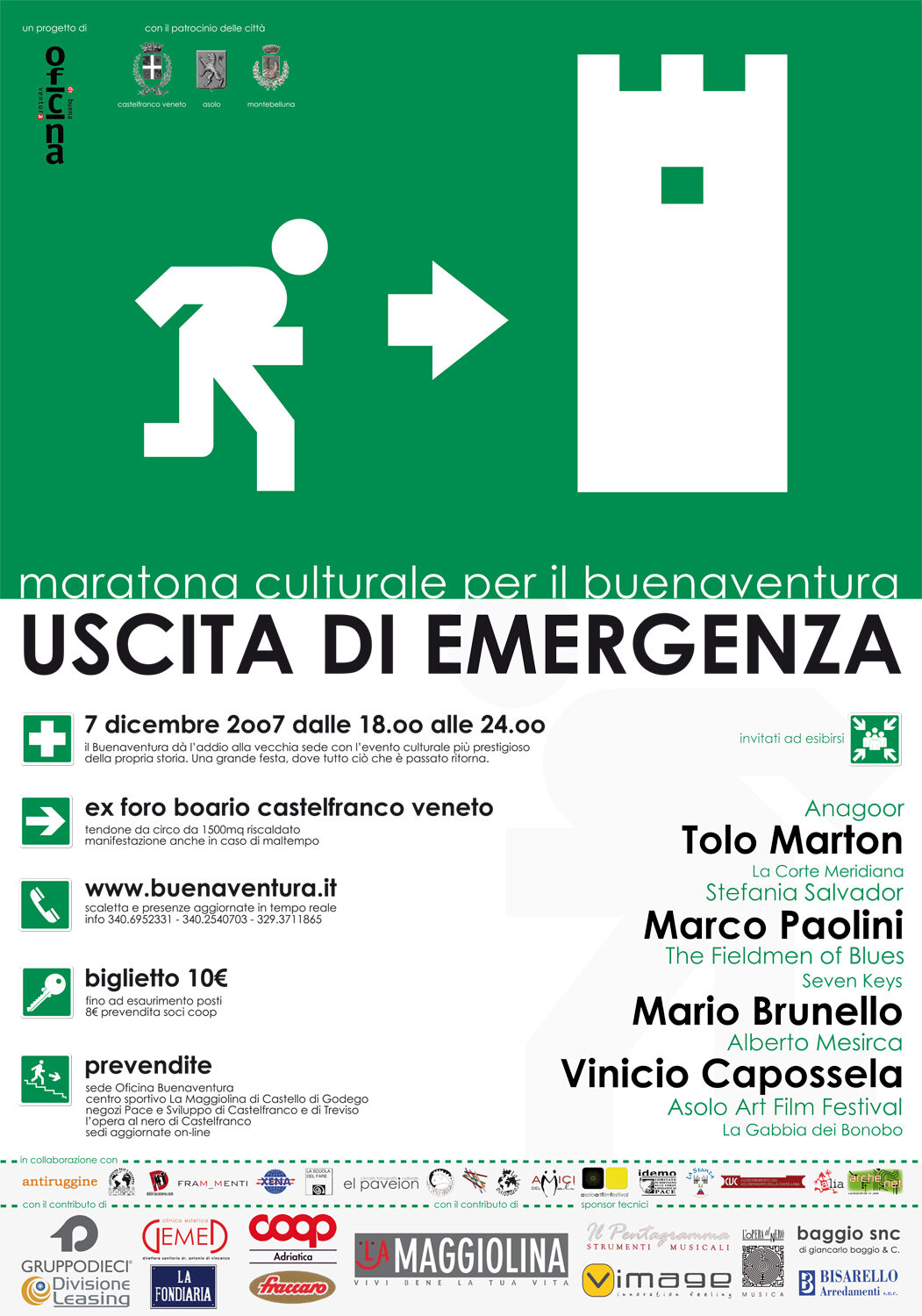
7 December 2007, 6 pm to midnight, ex Foro Boario, Castelfranco Veneto.
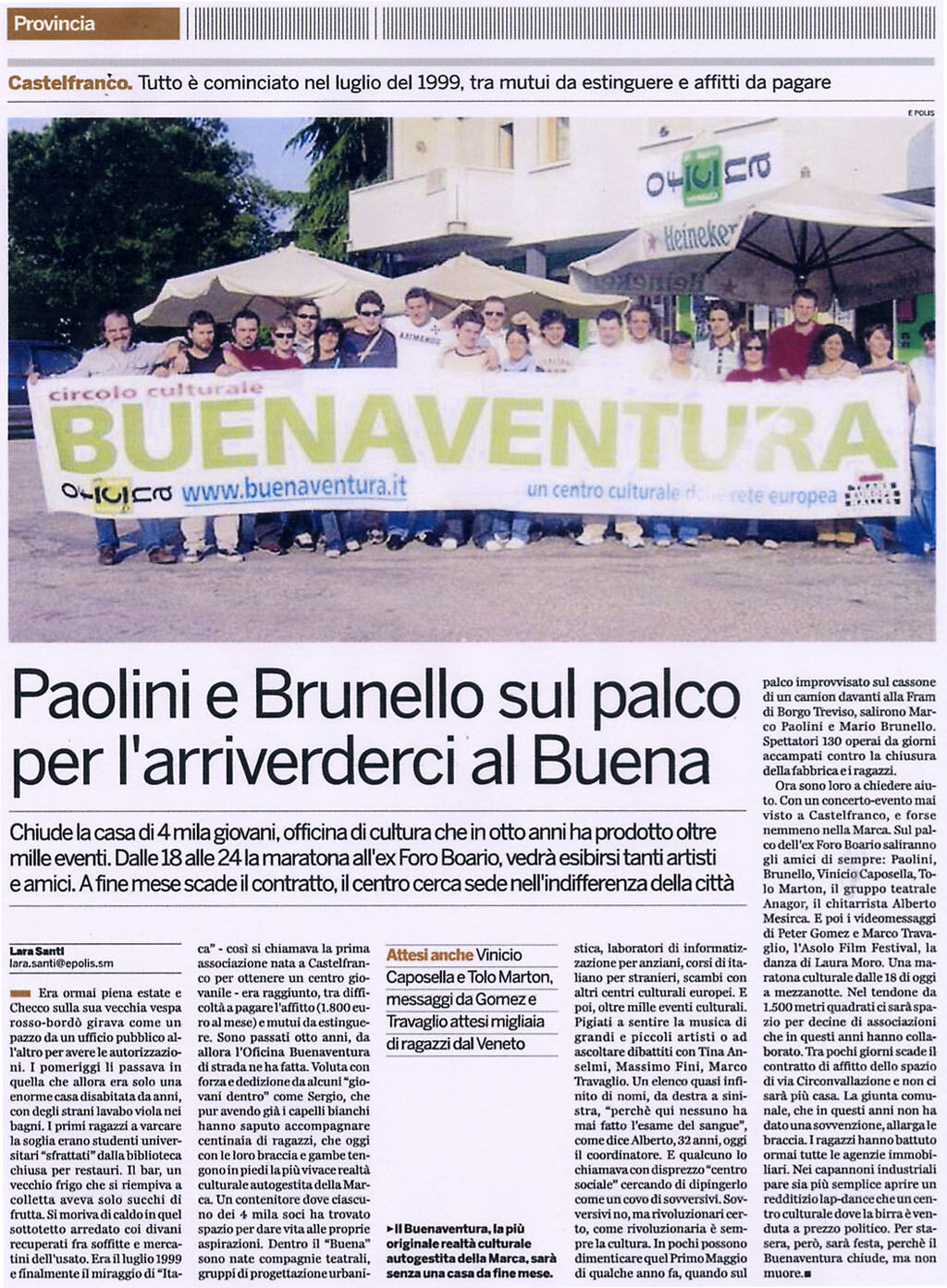
On stage, all gratis: Marco Paolini, Mario Brunello (cellist, born in Castelfranco), Vinicio Capossela, Tolo Marton (blues guitarist, longtime friend of the Buena who had already played there for free more than once and dropped by often), Anagoor (theatre company), Alberto Mesirca (classical guitar), The Fieldmen Of Blues, Seven Keys, dance by Laura Moro, the Asolo Film Festival, and others. Video appeals from Peter Gomez and Marco Travaglio. A 1,500 m² tent at the ex Foro Boario. 70 beer kegs. Live audio-video stream. Five local newspapers covered the closing — see also the Il Treviso article of 7 December 2007 by Lara Santi for a contemporary summary.
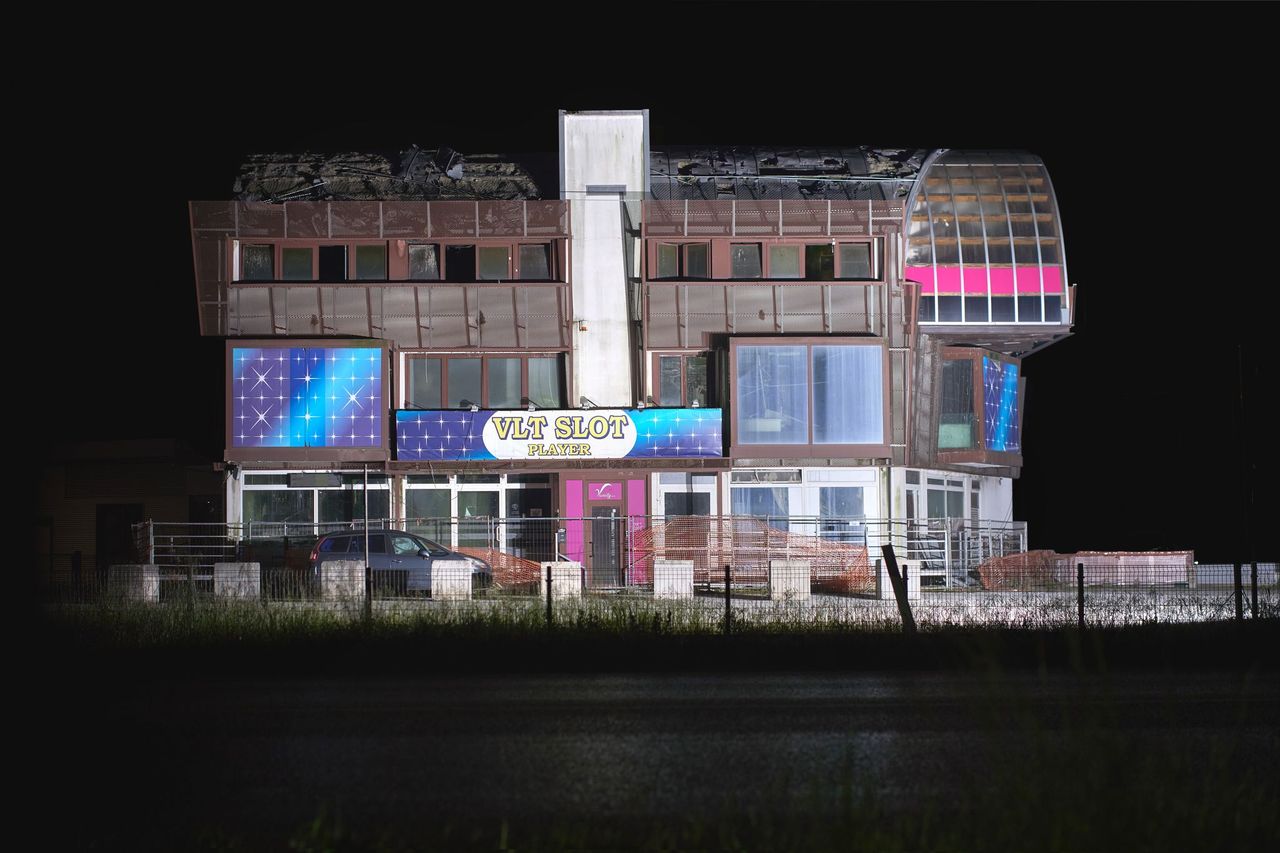
A few weeks later the building was emptied. Despite the owner’s stated intention to demolish it, the building was eventually renovated and reopened as a VLT slot-machine venue. It later partially burned in a fire. It is still there today.
2008–2010: the long aftertouch
Even after losing the building, the association kept doing things: a Gomorra screening, the Friends of Mali initiative, the Idemo exhibition, the Gianmaria Testa concert (11 October 2009, Solo dal vivo tour, the only Treviso-area date), an electromagnetic-pollution awareness campaign, a study-help service for students, plus several public conferences.
Then, slowly, a long pause began.
2011–2025: the hiatus
For 15 years, Buenaventura APS stayed legally alive, with about €26,000 in the bank, dormant. The website went on running until it was eventually compromised by Joomla SEO-spam and decommissioned.
Many of the people behind the Buena got on with their lives. Couples that had met at the bar got married, had kids, raised them. Some emigrated — France, Spain, Greece. Some travelled long. Some stayed in Castelfranco and took other paths.
For 15 years, no assemblies, no minutes, no projects under the Buena name — just freedom from the daily weight of keeping three floors, a basement and 600 square metres open for eight and a half years without ever closing.
The Collettivo foto social that started as a 2003 photography workshop at the Buena kept going on its own — and is still active today.
In 2014 the Italian state agency put the Venetian island of Poveglia up for auction. Some ex-Buena people, indignant, used the €26,000 still in the Buena’s account to register for the auction — “we’ll lose, but we’ll make noise and bring our European TEH network to bear”. They went to the first state meetings, where they met the people who would shortly found Poveglia per tutti (who initially mistook the Buena folks for private speculators). Cleared up, the Buena joined the Poveglia campaign as an association, helping with promotion and fundraising. In August 2025 the northern part of Poveglia was finally entrusted to Poveglia per tutti as a shared urban park.
In 2015–2016 another cultural centre, Spazio Zephiro, opened in Castelfranco. Built from scratch by people who self-organised on their own, but visited by many ex-Buena. They consciously copied the Buena’s legal architecture — two paired associations (a public-benefit one and a cultural one) for a single project.
2026 → restart
In the summer of 2025, a question started circulating among ex-Buena people: is it time to restart, somehow?
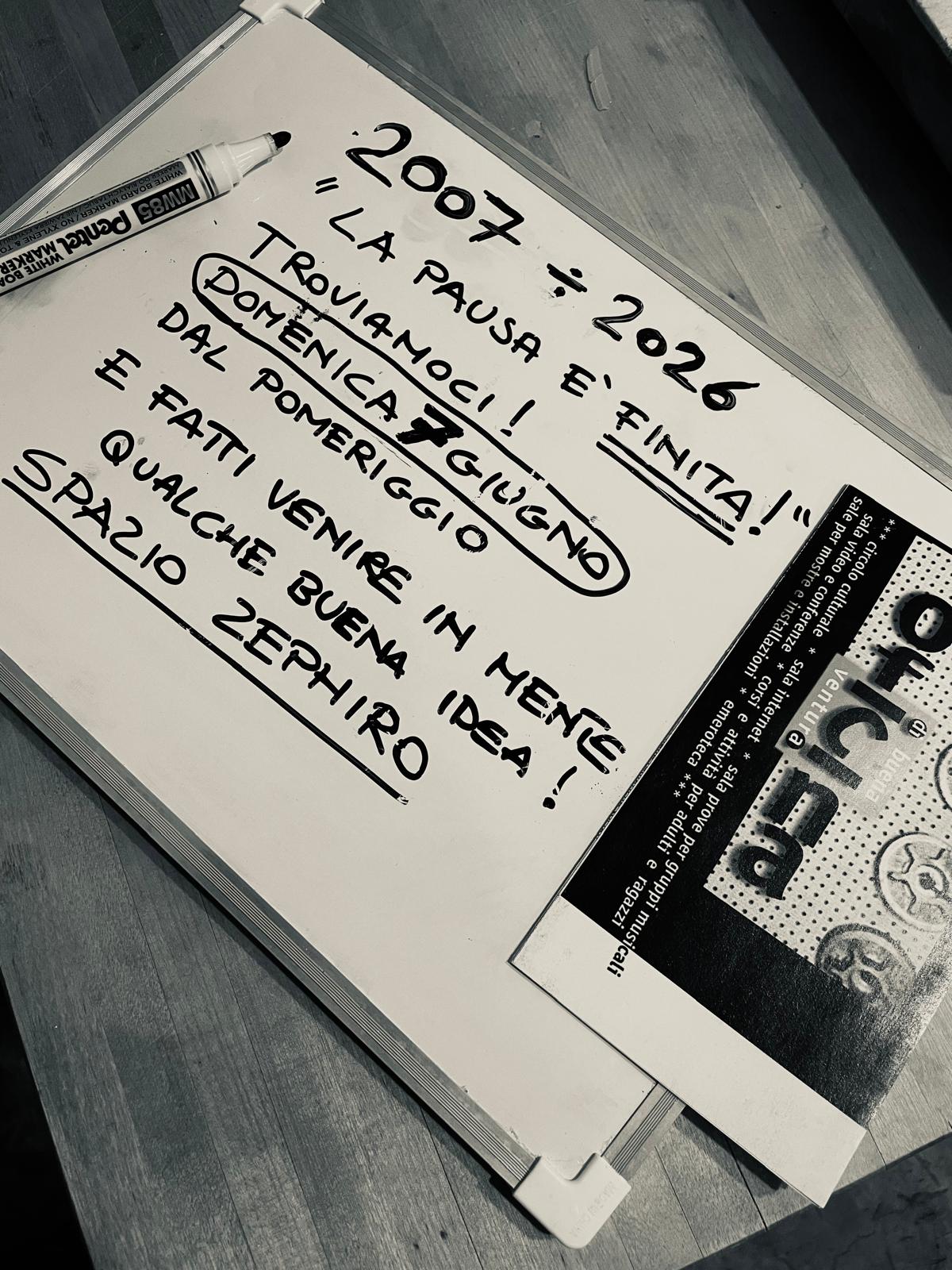
A spontaneous synchronicity of conversations, calls, meetings at the Spazio Zephiro bar, brought a small group of ex-Buena to a first concrete step: a public event on Sunday 7 June 2026 at Spazio Zephiro, Via Sile 24, Castelfranco Veneto. About ninety people showed up. The conversations were real, ideas surfaced on the boards, and a list of people willing to put their hands on it started to form. After that day, the restart is no longer just an idea — it has a serious chance of actually happening.
The slogan, hand-written on a whiteboard: “2007 ÷ 2026 — la pausa è finita!” — “the pause is over.”
Since then, things have moved step by step:
- 4 July 2026 — “From ideas to action”, in the exhibition hall of the Barchessa Zorzi in Riese Pio X: 28 people around the table, three debates on principles and, at the end of the day, the first working groups (commissioni) — on principles, spaces, finances and more.
- Weekly meetings since 5 July, open to anyone.
- 10 October 2026 — “Back around the table”, at the Cultural Centre in Vallà, hosted by the Due Mulini association: about twenty people, a small organising secretariat, a fixed place to meet every week, the principles document shared by everyone, and a new working group studying which legal form the association should take.
Anyone can join at any time and work in any group: leave your contacts here (the form is in Italian and asks for your name, email and phone number). Dates and next steps are on the events page (in Italian) — drop in, bring an idea.
Not nostalgia. Not a re-edit of the past. The world has changed and is changing faster every day. What we want is a slow, patient ground-up work: weaving experiences and skills, threading the generation that was there with the one that’s twenty now and with whoever just walked in. Building a physical space — a place where people meet for real, outside the closed boxes of screens — that is, from the root, a messenger of liberation.
To re-enchant ourselves, in order to re-enchant the world.
Get in touch
Email [email protected].
This site is still being built and checked: its content is pieced together from local archives and from people’s memories. If you spot mistakes or gaps, let us know.
Browse the archive (mostly in Italian):
- 📷 Event photos — over 4,000 photos from the 1999–2009 period
- 🎨 Event posters by year — over 400 posters from 1999 to 2010
- 📰 Press archive — newspaper articles about the Buena
- 🏛️ Castelfranco city council, 11 Jan 2008 — the public meeting where the Buena was discussed (videos)
- 💾 The original 2008 website mirror — Joomla content as it was, with statutes, budgets, the 1999 business plan, photos, posters
- 🏛️ TEH Meeting 2005 site
- 📚 BuenaWiki — internal volunteers’ wiki, ~1000 pages
- 🌐 ArcheNet — 2006–2007 regional project, ~2,600 pages